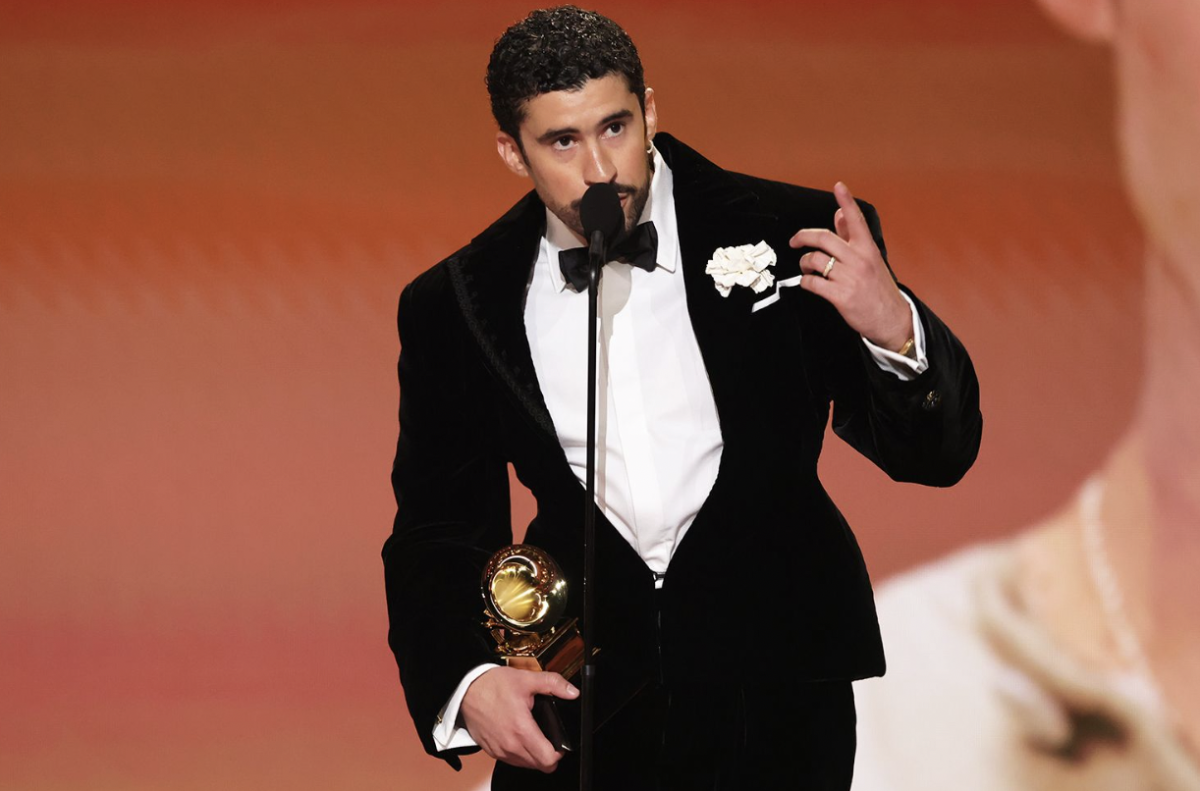
With each successive flash of the camera and the clamor of the paparazzi, widely acclaimed artists and celebrities step out onto the red carpet, hoping to leave that night holding the glossy, golden trophy. The 2026 Grammys took center stage as, yet again, one of the biggest events in the music industry, as artists brimmed with excitement at seeing their work recognized on such a massive scale. Not only are the Grammys a big event for the artists attending, but also for the people watching around the world, hoping to see some of their favorite musicians win an award. When their favorite artists do win an award, they give an acceptance speech. On stage, feeling the pressure of millions of eyes on them combined with overwhelming exhilaration, the artists thank their family, friends, listeners, producers, and the Recording Academy for making their win possible. The 2026 Grammys strayed from the norm in that some of the acceptance speeches didn’t follow this formula. Artists such as Bad Bunny, Billie Eilish, Shaboozey, Olivia Dean, Kehlani, and Bon Iver used their acceptance speeches to call out the injustices being committed by Immigration and Customs Enforcement (ICE).
Throughout history, music has always been the backbone of troubled times. From anti-slavery songbooks and songs written for presidential campaigns to pop stars performing for humanitarian aid, music has become increasingly intertwined with political events. In today’s world, times have been especially sensitive in regard to the wave of federal immigration enforcement in Minnesota under Trump’s administration (Operation Metro Surge). The killings of Renée Good, mother of three, and Alex Pretti, an ICU nurse, by ICE agents in Minneapolis have sparked a cascade of intense emotions among the city’s residents. People have been engaging in forms of protest, staying behind closed doors, and forming protection networks to warn neighbors of ICE’s presence. In addition, ICE’s detainment of five-year-old Liam Conejo Ramos and his father, Adrian Alexander Conejo Arias, in a Texas detention center for 12 days stirred up a high amount of controversy and outrage.
As a result of these events, many artists at the Grammys used the stage as a platform to speak out. When Bad Bunny won the award for Best Música Urbana Album, he didn’t hesitate to share his views with the world.
“Before I say thanks to God, I’m going to say ICE out,” Bad Bunny said. “We’re not savage, we’re not animals, we’re not aliens. We are humans, and we are Americans.”
Perhaps the boldest political statement ever made at the Grammys, the room broke out into an enormous standing ovation. While many praised him for his unprecedented move, critics such as White House Press Secretary Karoline Leavitt claimed, “It is ironic and frankly sad to see celebrities who live in gated communities…trying to demonize law enforcement.”
The use of an award show as a political platform quickly gained traction, as Bad Bunny wasn’t the only artist who felt compelled to use his voice. When Billie Eilish won Song of the Year, she took advantage of her time on stage to state a similar message.
“No one is illegal on stolen land,” Eilish claimed before cursing out ICE, her profanity censored in the Grammys TV broadcast.
Some artists engaged in more subtle forms of retaliation, such as Olivia Dean, when she won the award for Best New Artist. Filled with gratitude and tears, Dean referred to herself as “a granddaughter of an immigrant” before adding, “I’m a product of bravery, and I believe those people deserve to be celebrated.”
The Grammys stage wasn’t the only medium of protest. As music stars strode out onto the red carpet, many people noticed the black-and-white pins attached to their clothing that read “ICE OUT.” Their pins represented a new change in the entertainment industry: the emergence of political and even controversial topics getting their own spot on stage.
As if the 68th Grammys weren’t already memorable, the host, Trevor Noah, decided to take the excitement up a notch, possibly stirring up some controversy in the process.
“Wow, that is a Grammy every artist wants,” Noah commented after Eilish won Song of the Year, “almost as much as Trump wants Greenland. Which makes sense. I mean, because Epstein’s island is gone, he needs a new island to hang out with Bill Clinton.”
Noah’s reply to the audience’s shocked and amused reactions was, “…It’s my last year. What are you going to do about it?”
Upon the first mention of Noah’s subsequent departure after hosting the Grammys for six years, Noah remarked, “I believe in term limits,” a reference to Trump toying with the idea of running for a third term.
Trump didn’t take kindly to these comments and responded in a Truth Social post, saying, “Noah said, INCORRECTLY, about me, that Donald Trump and Bill Clinton spent time on Epstein Island. WRONG!!! I can’t speak for Bill, but I have never been to Epstein Island, nor anywhere close, and until tonight’s false and defamatory statement, have never been accused of being there, not even by Fake News Media.”
In the midst of the president’s not-so-internal fuming, artists making anti-ICE statements, and awards being announced, one thing became clear: the 68th Grammys turned a new leaf in how large-scale televised events will be conducted in the era of divisive politics. While the Grammys had its usual display of tearful speeches, flashy performances, and elusive charm, the golden gramophone was now served with a side of political protest. History ebbs and flows into times of obscure darkness and blissful stretches. As music has a way of lifting people out of deep despair, it seems fitting that the industry should take a bolder stance during darker periods in history. Perhaps then, with prominent figures speaking out for what they believe in, the turbulence surrounding the country can start to ease up a little.