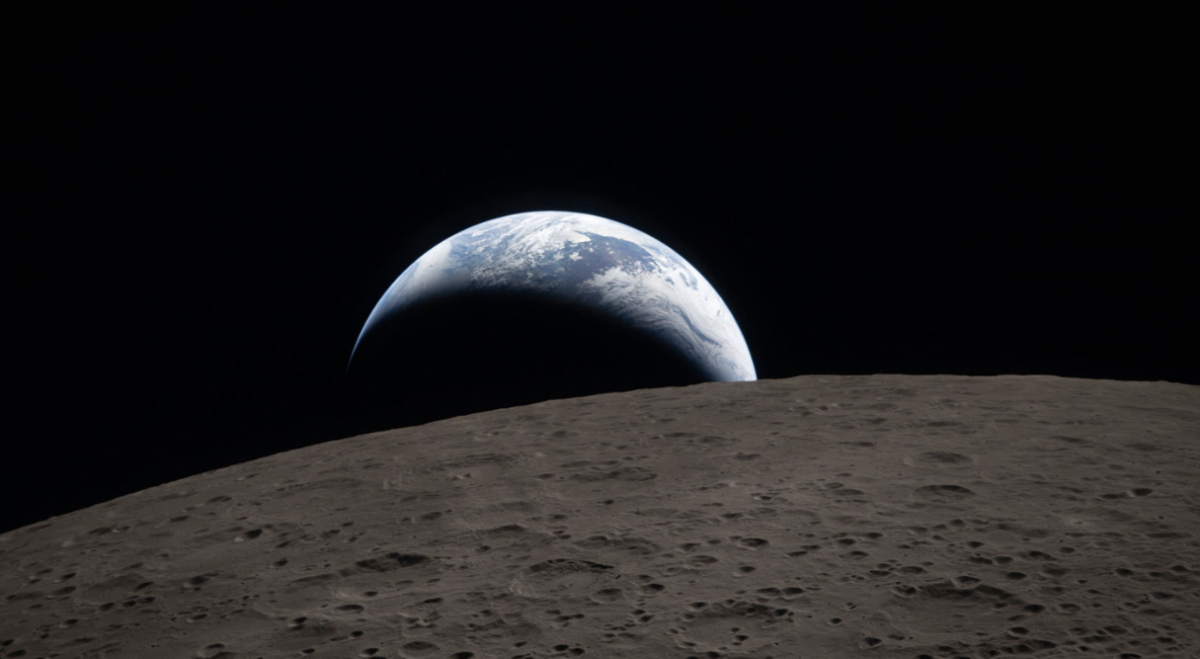
Space exploration took a renewed interest in the far side of the Moon as the Artemis II crew became the first to make the trip in over 50 years. That dark, seemingly impenetrable blanket that lies beyond the Earth’s atmosphere was opened to a realm of future possibilities as the Artemis crew successfully completed their mission. Now that the Artemis II crew has splashed back down on Earth, what did their mission actually accomplish, and what does it mean for the future of space exploration?
The main goal of the Artemis II mission was to test NASA’s Exploration Ground Systems, the Space Launch System (SLS) rocket, and the Orion spacecraft’s life-support systems. As a ten-day test flight, the mission provided data on future missions to the Moon and determined if the spacecraft could support a sustained lunar presence based on its performance. The historic Artemis II crew consisted of Reid Wiseman; Victor Glover, the first person of color to go to the Moon; Christina Koch, the first woman to go to the Moon; and Jeremy Hansen, the first Canadian to travel to the Moon. The crew was tasked with testing the life-support systems, emergency equipment, manual spacecraft operations, and studying the lunar surface. Differing from the renowned Apollo 8 mission, where the spacecraft orbited the Moon, Artemis II did a lunar flyby without actually entering the Moon’s orbit. Compared to previous lunar missions, Artemis II emphasized deep-space exploration and acted as a measure of capability. During their voyage, the crew witnessed Earth’s crescent setting below the lunar horizon, an already popular photo known as Earthset. Drawing similarities to Bill Anders’s Earthrise photo during Apollo 8, the crew experienced the “overview effect,” which describes the awe, wonder, and strong connection to humanity that astronauts experience when viewing Earth’s small size and fragility from space. In addition, the crew was treated to an hour-long solar eclipse and the display of meteoroid impact flashes on the Moon.
“I just had an overwhelming sense of being moved by looking at the Moon. It lasted just a second or two … but something just threw me suddenly into the lunar landscape, and it became real,” Koch said.
While the Artemis II mission gathered mesmerizing pictures from space and made advances in the once-abstract concept of a long-term lunar presence and Mars missions, there are still some drawbacks when it comes to space travel.
A podcast on Scientific American’s Science Quickly addressed these concerns when Kendra Pierre-Louis, a climate reporter, raised the question of whether Artemis II was really the best use of taxpayers’ money, as many Americans are struggling with high gas prices and putting food on the table. Considering the amount of excess government spending that goes on in other areas, views differ on whether putting this money toward understanding our own universe was worth it. In addition, rocket launches result in an increase in emissions. In a world slowly becoming more fragile due to climate change, focusing on climate-intensive rocket launches may be counterintuitive. As a result, there may be a line between how much harm should be done to our world in order to explore another.
Nevertheless, when looking at Artemis II without weighing it down with socioeconomic and environmental concerns, its true intention shines through. The mission taps into the childhood wonder and curiosity of people all over the world, proving to them that they can achieve their dreams. It is a step toward a better understanding of ourselves, humanity, and the pale blue dot we reside on. In a world constantly overburdened with politics, wars, and climate change, it can help to view things from a different perspective. Seeing the blue crescent of the Earth, with its swirls of white and its large green landmasses, can inspire hope and awe in people, reminding them that nothing is too far out of reach.
“Fifty-three years ago, humanity left the Moon,” said NASA Associate Administrator Amit Kshatriya. “This time we returned to stay. The future is ours to win.”